FILMIQ / AI PRODUCT EXPERIENCE
Making intelligence intuitive
Transforming fragmented production data into a contextual, trustworthy experience for the entertainment industry.
ROLE
Fractional Chief Experience Officer
SCOPE
AI Product Strategy & Experience Design
THE CHALLENGE
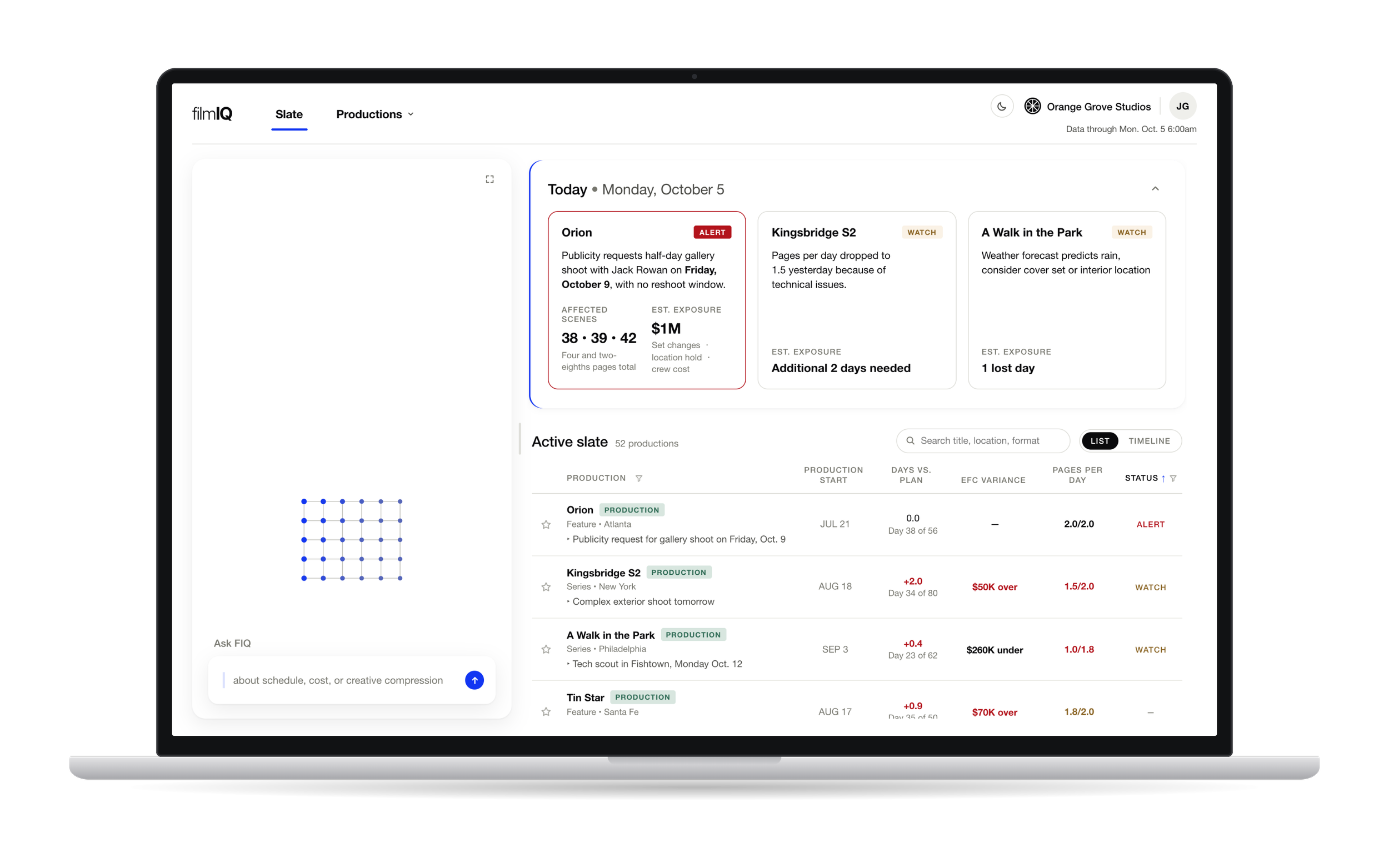
Film productions generate enormous amounts of information across schedules, budgets, contracts, and production documents. Yet the information needed to make decisions is often fragmented across systems, teams, and files.
filmIQ set out to make that information accessible through AI.
The design challenge was to translate that ambition into an intuitive product experience—one that would allow studio executives to ask questions, understand the answers, and explore the underlying information without navigating the complexity behind it.
Intelligence trapped in complexity.
THE APPROACH
filmIQ had a compelling vision for transforming how studios interact with production information. But communicating that vision required more than describing what the technology could do.
My role was to translate the concept into a tangible product experience.
I developed an interactive demonstration built around a realistic production scenario, allowing executives to see how filmIQ could move from a high-level view of their slate to specific production questions and the source documents behind each answer.
Rather than showcasing AI capabilities in isolation, the experience demonstrated how they could come together in a coherent, intuitive workflow.
From concept to experience
THE RESULT
Beyond the dashboard.
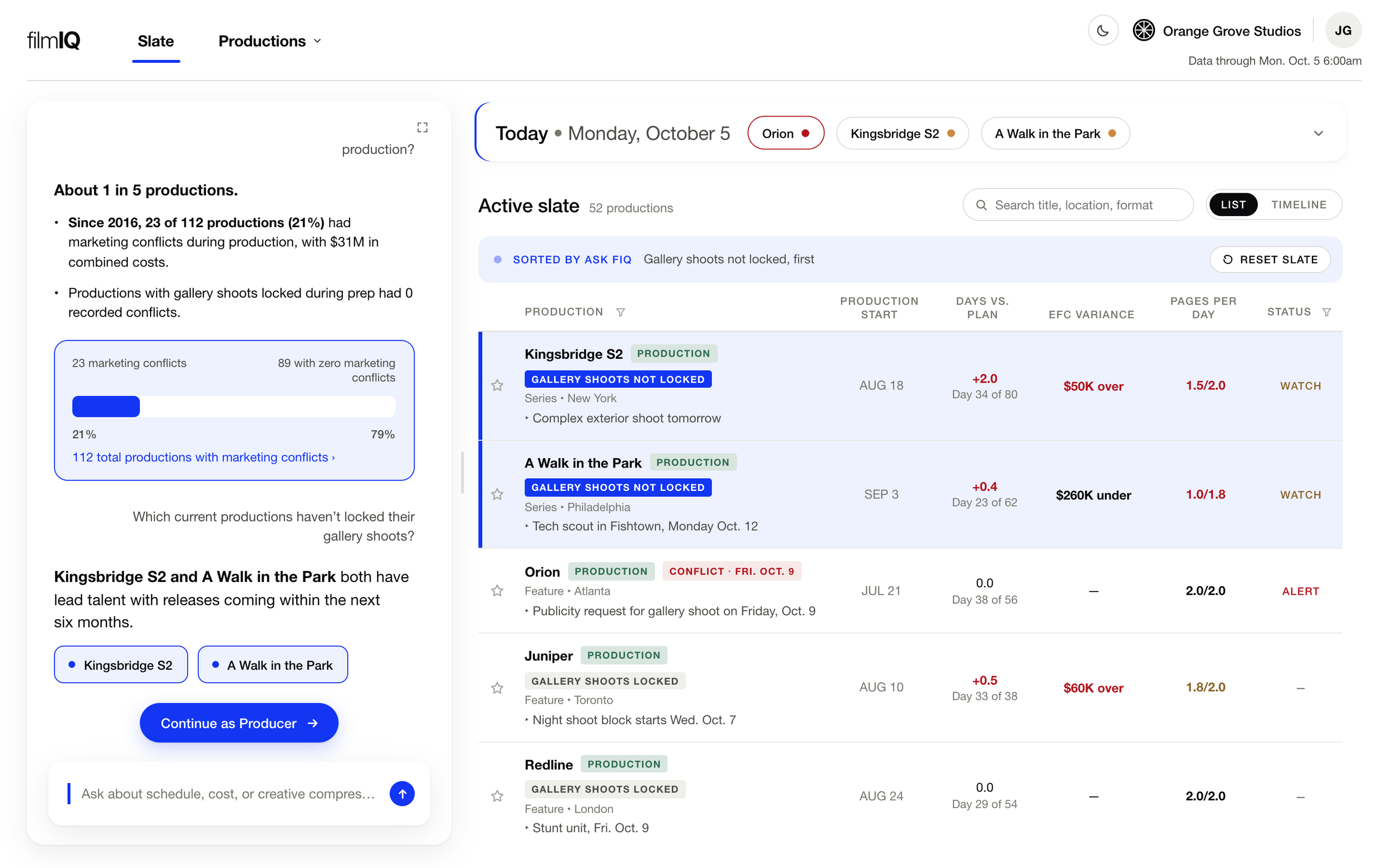
Traditional enterprise software organizes information around systems, menus, and predefined reports. But studio executives don't necessarily think in terms of where information lives. They think in terms of the questions they need answered.
I designed the filmIQ experience around that distinction.
Rather than requiring users to navigate multiple dashboards, the interface allows them to begin with a question and progressively explore the information behind the answer.
A persistent conversational interface maintains context as the surrounding workspace adapts to the task, presenting relevant production details, visualizations, and supporting information.
The goal wasn't to eliminate the interface. It was to make the interface respond to the way people naturally think and work.
Answers are only as valuable as their source.
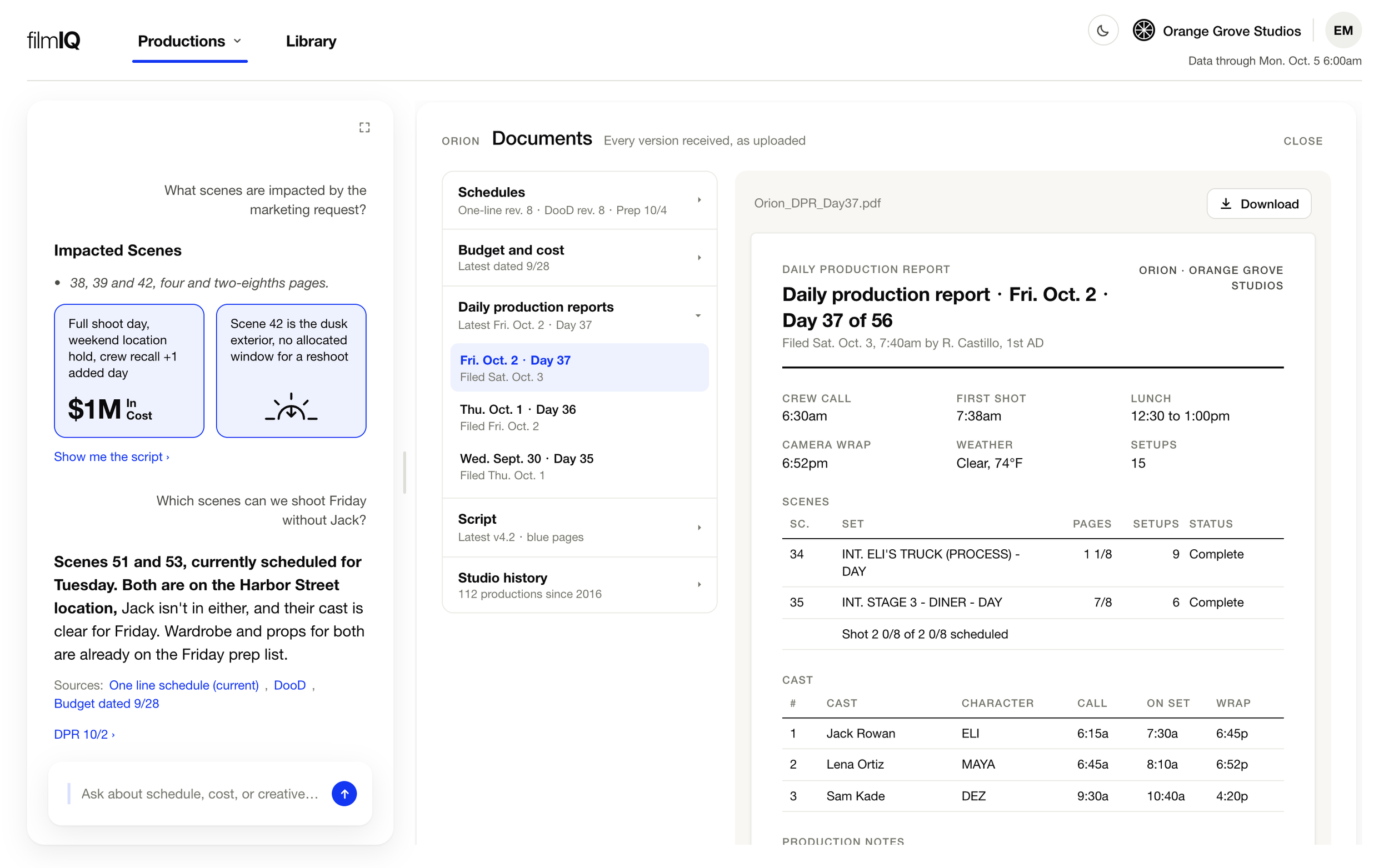
Introducing AI into complex production workflows creates a fundamental design challenge: how can users trust information when they can't see where it came from?
I approached this by treating transparency as a core part of the experience, rather than an additional feature.
Responses were designed to be factual and grounded in production records, with clear pathways to the underlying documents. Users could move from a high-level answer to the supporting evidence without losing the context of their original question.
The result was an interaction model that balanced the speed of AI with the transparency and control required for consequential decisions.
The goal wasn't to replace human judgment. It was to give people better information to exercise it.
A vision you can experience.
The result was a cohesive, interactive product experience that brought filmIQ's vision to life.
What began as a complex technical concept became a tangible demonstration of how studio executives could interact with production intelligence—moving from broad questions to specific answers, visualizations, and supporting documentation within a single experience.
The work established an initial interaction model for filmIQ, demonstrating how conversational AI, contextual interfaces, and transparent information could work together.
More than a collection of screens, the deliverable was an experience that made a new way of working understandable.